When planning a ground-mounted solar installation, choosing between concrete vs screw foundations is a key strategic decision. This choice directly impacts the system’s durability, cost, and performance. Here’s what you need to know to decide based on your site conditions.
Concrete or screw foundations?
Which option fits your soil, constraints and long-term goals best?
This comprehensive guide helps you make the right technical, budgetary and strategic choice for your ground-mounted solar project.
📌 What is a Foundation for a Ground-Mounted Solar System?
Foundations connect the solar mounting structure to the ground and transfer mechanical loads—such as module weight, wind and snow—safely into the soil.
Two main foundation technologies are used:
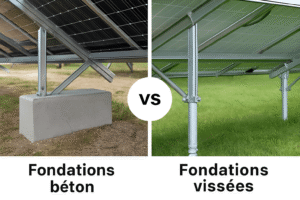
- Concrete foundations: slabs or poured blocks cast on-site
- Screw foundations: steel piles mechanically anchored in the soil 👉 See also: Advantages of ground-mount solar systems
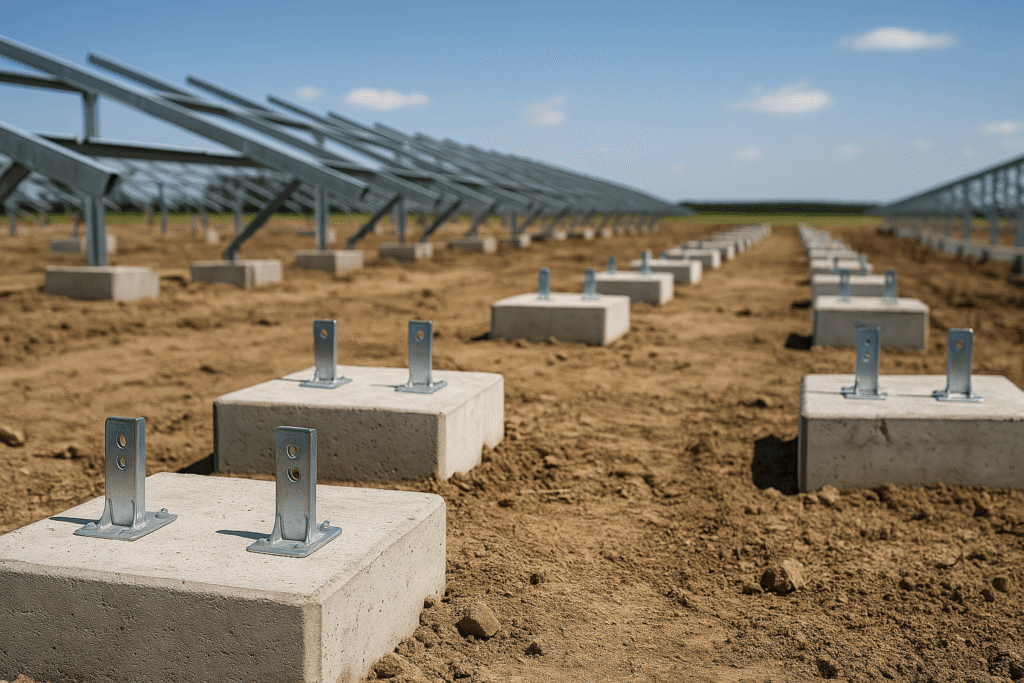
🧱 Option 1: Concrete Foundations
Concrete foundations are a traditional solution used where high mechanical resistance is required or where soil conditions are challenging.
✅ Advantages:
- Excellent stability even in high-wind areas
- Long service life (25+ years)
- Ideal for heavy, permanent structures
⚠️ Disadvantages:
- Long installation time (excavation, formwork, drying)
- Higher overall cost
- Larger carbon footprint
🔩 Option 2: Screw Foundations
Screw piles are increasingly popular for agricultural or industrial solar installations on softer soils.
✅ Advantages:
- Fast installation (no curing required)
- Minimal earthwork needed
- Reversible: can be removed without damaging soil
- Lower labor and material costs
⚠️ Disadvantages:
- Soil quality dependent (requires geotechnical survey)
- Less effective on rock or very dense soils
- Requires anti-corrosion protection
⚖️ Comparison Table: Concrete vs Screw Foundations
| Criteria | Concrete Foundations | Screw Foundations |
|---|---|---|
| Stability | ⭐⭐⭐⭐⭐ | ⭐⭐⭐⭐ |
| Installation time | Slow | Fast |
| Total cost | High | Moderate |
| Ecology | ❌ | ♻️♻️♻️♻️ |
| Reversibility | No | Yes |
| Suitable soil type | Hard, rocky | Soft, clayey |
| Maintenance | Low | Low to Medium |
🧪 How to Choose Based on Soil Type
The type of soil is the number one factor. Always conduct a geotechnical study before deciding:
- Clay or sandy soil ➝ Screw foundations
- Rocky or dense soil ➝ Concrete foundations
- Temporary project ➝ Screw piles
- Permanent project in a high-wind area ➝ Concrete
🧠 At SMI Grup, every project starts with:
- A topographic analysis
- A custom structural design
- In-house manufacturing of profiles and supports 👉 Learn more about our custom solutions
📚 Additional Resources
- 🔗 Wikipedia – Photovoltaic mounting systems
- 🔗 SMI Grup – Why choose a metal structure for your solar installation?
🎯 Conclusion
The right foundation choice depends on:
- Soil conditions
- Available budget
- Project lifespan
- Logistical constraints
📞 For a customized assessment contact our engineers for a free pre-analysis.